02/12/2015 — No Comments

3D Printed miniatures from 3D scans

Recently I have been exploring the use of the 3D printer, and one of the avenues I've been experimenting with is using the 3D printer to produce miniature figures.

The process is relatively straight forward, we use a 3D hand scanner coupled to a laptop to 3D scan the person. This captures the figure in 3D, and works incredibly well. We then refine the 3D mesh, fixing errors, or adding parts which the scanner hadn't quite scanned correctly, and then we send it to the 3D printer.

3D Scanning & Printing Railway Modellers 16mm

The above figures were created for use with model railways, and are printed at a scale to match the railway. These figures stand at approximately 95mm high (a scale of 16mm - 1ft), but figures can be produced to other scales quite easily.

Once the prints are complete, they are then handed over to the customer, who can refine, sand, and paint the figures as they desire! Here are two figures I painted, badly, but if gives an idea of what can be achieved!

3D Scanning & Printing Railway Modellers 16mm

I'd love to see what a professional miniature painter could produce, if you are a painter, get in touch, it would be amazing to collaborate!

Anyway, that's what the 3D printer has been doing recently, and it's definitely been a learning curve, but adds something a bit different and alternative to the Ard Digital portfolio!

Finally, if you're potentially interested in being imortalised as a 3D printed miniature, have a read at the 3D Scan & Print a Miniature You page and of course get in touch!

Dean

11/11/2015 — No Comments

360 Degree Video Test – 3D Interior Apartment

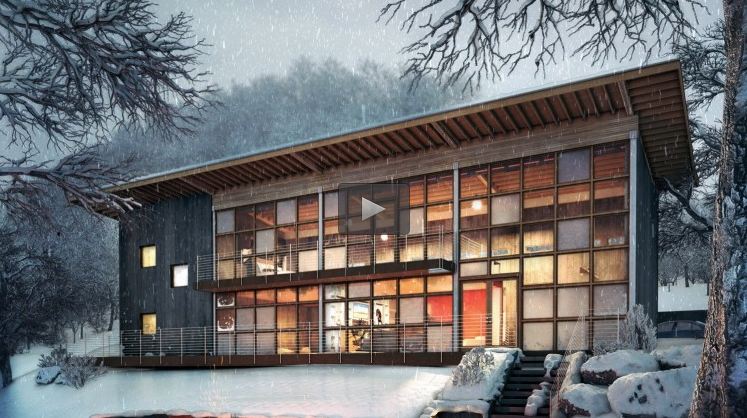
Earlier this year YouTube made it possible to upload 360 degree videos! If you don't know what they are, 360 videos enable the viewer to look around the space, as if they were there, whilst the video is playing!

I wanted to see what the possibilities could be for CGI and 3D rendered environments, I'm always interested in new tech, and different ways of doing things, so it made sense to spend some time investigating, testing and developing.

The video below is the test video I produced. It's a very simple interior room set, with a basic camera movement forwards and backwards, but that's all I need for this test. When you play the video it will play just like a normal YouTube video, however if you click and drag (if you're on a PC browser) on the video you'll be able to look around the 3D environment! Give it a go....

The video can also be viewed on Youtube here.

If however you are viewing the video on the YouTube app on your smart phone (I have a HTC One M8), then hold the camera as if taking a picture of a wall, and move the phone to look around! It really is quite amazing!!

However the fun doesn't stop there, whilst in the YouTube app, you'll possibly see the Google Cardboard logo, and if you have a Google Cardboard (if you don't, jump on Amazon and order one for around £15!), click the Cardboard logo, and now you can view the video in the Google Cardboard head set!

Google Cardboard VR Headset Interactive

The Google Cardboard.

So what does this all this mean? Creating demos like this are always extremely valuable to do, they allow me to test, experiment, fail and play with something new and exciting, and that's half of the reason why I love the industry I work in!

But does it have any practical future applications? I'm sure when it comes to presenting content to users, more immersive and engaging content is going to be a massive plus to any project. I don't see why an architect couldn't use a 360 degree video to present their new building, or instructors aid their students with more engaging training, or even being able to watch a theatre performance as if stood in the centre of the stage!

The possibilities are endless! Of course there has to be a purpose to using 360 videos, in some applications it just wouldn't add anything, but in many situations I see the potential use of 360 videos to push video and user engagement to the next level!

05/11/2015 — No Comments

New Development Project – Loft Office

From time-to-time, we get the chance to try new things, move in a different direction (even it's only for a short while), and experiment with something outside of the day-to-day work, and being in the CGI / visualisation industry means that nothing stands still, and there's always an opportunity to develop, test and explore.

One area I've been wanting to explore is the interactive / virtual reality side of the industry. Interactive walk though, virtual reality, and other tech like this has been around for decades, and it's concept is nothing new, but I'm sensing a trend towards these applications more and more. The hardware is more accessible than ever, with it the computing power required now literally pocket sized with the advances with smart phones and tablets.

Anyway, I digress from the blog posts title, over the next few weeks / months / when time allows, I will be creating a virtual reality environment, a loft style office. The user will be able to walk around the space, explore the architecture, and interact with several objects. How far the interactivity goes may depend on time, but I think it would be great to add some quirky elements in there too.

2015-11-05 11.19.06

Quick sketch to kick off the new project.

I will be learning and building the virtual reality environment inside 3Ds Max (my standard 3D application), and Unreal Engine 4. Unreal Engine looks very exciting, giving a massive amount of control to us creatives, whilst making the programming less complex than other packages.

In the past I have sometimes viewed virtual reality as a bit of a gimmick, with no real purpose and too many limitations, but recently my attitude has changed as I see a massive improvement of visual effects that may soon rival traditional CGI, and the access to consumer-ready hardware, meaning you don't need a £2000 PC to view a simple interior.

Also, I'm very excited for 2016, when it looks like we may be treated to more virtual reality head sets. The Occulus Rift will be out of development and consumer ready, and others such as Sony, and HTC are also releasing their versions very too which all look very promising and may really shift the industry and projects more towards virtual reality.

Anyway, the loft office project has started! It may take a while to complete, but I'll be posting small updates as soon as I can, and also check out my instagram (@punch_ard_digital) and Twitter (@deanpunchard) for even more frequent, and even slightly random posts!

Dean


02/11/2015 — No Comments

Augmented / Virtual Reality Command Centre Concept

New tech excites me, and this augmented / virtual reality project created for BAE Systems is something I'm massively impressed with. In an episode of Click, a BBC tech based show, they look at how augmented and virtual reality work in partnership to give the user a huge amount of control by immersing the user into a virtual world.

The video can be watched on the iplayer here -

http://www.bbc.co.uk/iplayer/episode/b06bbm1g/click-05092015

The command centre uses a mix of new technology, with perhaps the most recognisable tech being the Oculus Rift (the large head set), but the command centre also takes advantage of gloves, cameras, and other interfaces to allow the users to view, control and interact with the virtual world.

VR AR Command Centre Virtual Reality Augmented Reality

Mixing virtual reality with augmented reality has been used to great effect, in this case the wooden table is used not only to project the virtual world onto, but also to give the user something real to touch. I imagine it's also very useful for resting the users hands, as hovering in mid-air can soon become quite tiring.

VR AR Command Centre Virtual Reality Augmented Reality

The augmented virtual world is mainly projected onto the table, however other 3D objects are visible away from the table, such as the fighter jet, and the personal assistant.

VR AR Command Centre Virtual Reality Augmented Reality

The software developed for the command centre is perhaps the most impressive part of the project, and gives us a brief look into what's possible. In this demo the user can quickly see live video from the real world scene, but the view could view anything they need, from drawings, to written reports.

VR AR Command Centre Virtual Reality Augmented Reality

The video also glimpses at another peice of tech which I love, and that's 3D scanning. In the video the command centre can see real-time updates from 3D scanned data. Presumably the area is scanned with a drone, and the point cloud data transmitted back to the virtual world.

VR AR Command Centre Virtual Reality Augmented Reality

If you're interested in this kind of tech, watch the video, it's seriously impressive stuff! I can't wait until this kind of project becomes mainstream, and eventually the norm, until then I'll just have to keep tinkering and experimenting with my own virtual worlds!

Dean


22/10/2015 — No Comments

Stock and Custom 3D models in CGI Visualisations

Throughout my CGI work, the scenes I create will be primarily populated with the building or product, but to set the scene props, landscapes, entourage, etc are added. These items, big or small have to be created and added to the 3D scenes.

Sometimes we use stock 3D models, which are very similar to stock photography. There are websites where you can download a wide variety of 3D models ranging from costing nowt, to hundreds of pounds. Once downloaded, the 3D models can be dropped into a virtual scene and used within the visualisation or animation.

With the majority of my projects I will 3D modelling various parts of a scene. In architectural visualisations I will model the buildings, landscape and other items, then populate the scene with stock library items such as cars and trees. I do this simply because the stock models available for foliage and vehicles is pretty extensive, and it would be counter-productive for me to start modelling these items, which could make the final cost of the CGIs too expensive for many. A collection of 10 cars can be purchased for a few hundred pounds, where as for myself to 3D model just one car would take at least a week, which makes a typical architectural visualisation just too expensive and time consuming.

architecture_nb_shot_2_final_1600Stock foliage used within a custom 3D modelled environment.

With interior visualisations and digital room sets, I find myself using less stock 3D model, in favour of hand creating custom items. My preference to do this has many factors.

  1. Trends within interior design changes on a monthly basis, and as such many of the stock 3D items are dated, and have sometimes been created years ago. This is OK for the design classics, but for items that change with the seasons it's not ideal, and can really impact on the final image.
  2. I can create almost any item in 3D, without it impacting on project costs or time too much. 3D modelling can be very tricky, and getting items to look realistic can also be hard, if not impossible for some, however when I started in the CGI industry over a decade ago (ouch), my speciality was 3D modelling, and doing it fast and good! Over the years I have continued to build on this core skill, evolving processes with every year, taking advantage of new techniques and software to be able to quickly create virtually anything.
  3. Purchasing 3D models from stock sites isn't always straight forward, first you have to find the right model, at a good price (I am a Yorkshireman after all!), and then trust it's OK to use. Then once I've bought the models, approximately 50% of the time the 3D models will need adjustments such as re-scaling or fixing errors, and nearly every time I need to check the 3D model material finishes to be in-line with my techniques and processes. This can be time consuming, and could also become costly.
  4. If I create the 3D models from scratch, I know the models are good, correct and error free. Maybe I'm not very trusting, or perhaps I just have faith in my own skills! Either way I know when I've 3D modelled an item that it's going to look good in the image, and if it doesn't look quite right, I know how to break it apart and improve it.
  5. The final advantage of creating custom 3D items is that they belong to me! I will add items to my personal library for future use, and I will also re-sell the 3D models though my TurboSquid account to other folk. I must admit I don't receive much in the way of sales, but it pays for my dropbox account at least!

Franke Sink Tap 3D Model CGI Kitchen

Franke sink and tap created from a handful of photos and dimensions.

Franke Sink Tap 3D Model CGI KitchenA wire-frame shot showing the 3D construction.

Although creating the 3D models from scratch has it's advantages, it also has its disadvantages. Some items can be very difficult to re-create in 3D. Items such as cloth, plants, and other organic forms can be tricky, so much so that it's not uncommon for these type of items to be photographed in the studio, and super-imposed into the CGI in post-production. This is purely a time-saving technique, anything can be created in 3D, it's generally a matter of how much time is available to complete a job.

modelling_toaster_dualit_01_1600

Dualit toaster, available to buy on TurboSquid

Other disadvantages could be that an items has little information or imagery to create an accurate 3D model. For example it's quite rare to find a piece of furniture photographed from every angle, instead usually the only reference is an angled photo, and generally the photograph will be of medium - low quality or resolution. So to create the furniture does require some educated guess work, and as such can't be too accurate. Clients will sometimes be able to physically send items to be turned into 3D models, which means a greater accuracy can be achieved, and is generally the only way to be certain of getting the 3D model just right.

Although I do find creating 3D models from scratch very useful, sometimes I do purchase 3D models. For interior room sets, I will often pick items from Design Connected, and occasionally TurboSquid and 90% of the time I'll be happy with the purchases. Purchasing these type of models will help speed up the process, which is very useful on projects where time is limited.

Both buying and creating 3D models has its advantages and disadvantages, and the majority of the time the decision to buy or make is made on a project by project case. As I've mentioned cost and time are two factors, however if possible I will always aim to use items I've created myself, this ultimately helps keep my work fresh, up to date and unique.

Dean

19/10/2015 — No Comments

WutheringBytes 2015

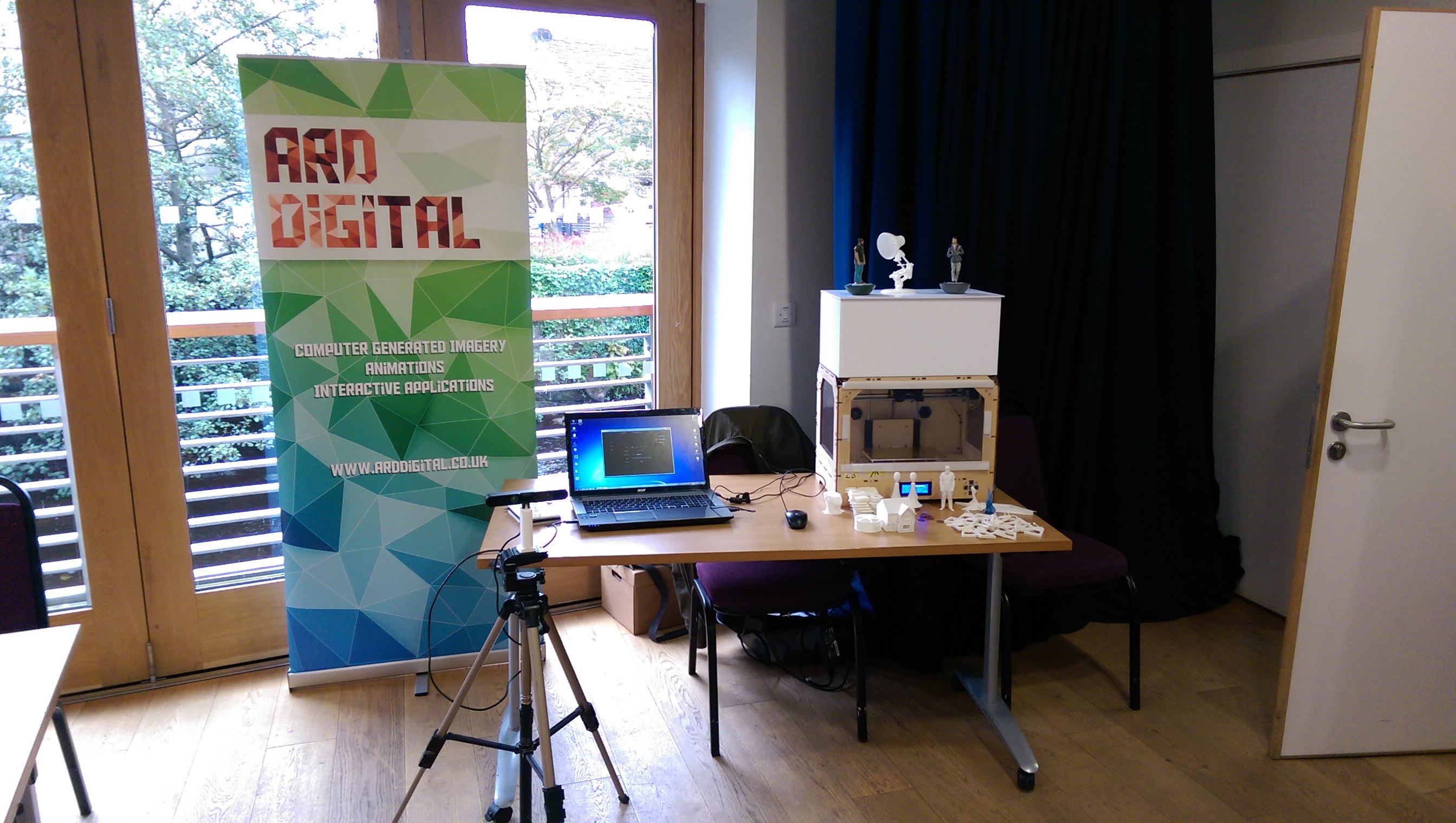
A couple of weeks ago I attended WutheringBytes over at Hebden Bridge to demo, show and explain 3D scanning and 3D printing.

WutheringBytes was set-up by Calderdale Council, to allow the public, companies, and anyone else to learn, engage and be a part of various technologies from numerous individuals and organisations. The wealth of technologies within our local area is fantastic, and I hope this event help to open people's eyes to just what's out there.

For my part in the event, I ran a 3D scanning and 3D printing demo. Through out the day I scanned anyone who wanted a go at turning themselves into digital versions.

3d scan scanning print printing

3D printer and scanner ready to go!

The response to the 3D scanning was fantastic, people couldn't wait to be scanned, and see themselves in digital 3D form! The scanning takes a few minutes, and as such the person being scanned has to stop completely still, which is harder than you'd think! The best response to the scanning was from the crowds of primary school children, who all wanted a go!

3d scan scanning male

A 3D scan from the day.

I will be sending the 3D scans to each person once I've had chance to sort and tidy the 3D files, and if they agree, I'll upload the scans so anyone can print or play with the 3D files.

I also gave away 3D printed bottle openers, some freshly printed that day. A penny coin slips into the bottle opener to give a hard edge to stop the plastic from breaking.  This is actually the last one I have from around 100 being printed! There's also the same bottle opener, but has ard Digital logo incorporated. I must print a few more!

Blog_WutheringBytes_3

3D printed bottle opener.

So that's what I got up to at WutheringBytes, be sure to keep an eye out for next years do, I'm sure it'll be a good one!

Dean

19/10/2015 — 4 Comments

Udemy 3ds Max & Vray Arch Vis course coupon for FREE access

The guys over at Udemy have given me 50 free coupons to allow my lucky followers to receive this course for free!

https://www.udemy.com/intro-to-architectural-visualization-using-3ds-max-and-v-ray_zillus/#/

The course is aimed at beginners, but as always there might be some tips and tricks even the seasoned pro's might have missed.

AD15_Blog_Udemy_Course

To receive the coupon, all you need to do is subscribe to the ard Digital newsletter, and in the comments section of the sign-up form type "free course", and I will then email the coupon code to the lucky first 50 subscribers!

Dean

02/09/2015 — No Comments

The Blanks ready to download and 3D print on Thingyverse

As part of the constant tinkering and testing with 3D printing, I have released a free download of 2 little characters I have created. "The Blanks", as I've named them, are two little characters, 10cm in height, with no real distinguishable features, perfect for a blank.

The 3D models have been uploaded to Thingiverse, click to go to the website to download them for free.

But what is a blank? MakerBot released Zee Blank, and the concept is to 3D print your own blank, and modify it however you please. Some of the creations on the Makerbot site are brilliant! The concept behind The Blanks is the same, print the 3D models, and then modify, paint, customize to your hearts content, then share your creation with the world.


the_blanks_print_01
The Blanks, 3D printed and awaiting customization.

I wanted to create The Blanks as an alternative to Zee Blank, as I felt Zee Blank is just too big, and very masculine in form. I created the couple as a male / female combination, but either could be modified to what ever gender you like.


the_blanks_screen_grab_01
The 3D model is set-up ready to print.

The Blanks are printed in several parts, which then fit together perfectly without the need for glue. Ideally the prints need to be sanded first, then painted to give a nice finish, or alternatively you could use a high build-up primer to give a smooth finish. The choice really is yours, and I can't wait to see how The Blanks will be modified. I will be having a go myself very soon, please don't laugh at my below average painting skills, I'm far more capable with a mouse and keyboard than a brush and paint!!

In the future I plan to release "add-ons" for The Blanks, maybe some new shoes, different heads, and possibly other props too. Let me know what you'd like to see added, and of course let me know if you have any comments! Follow me on Thingiverse here and of course sign up to the mail list to hear of the latest releases and info.

Also send me pictures of your creations, I'd love to feature them on the blog too!

Dean


25/03/2015 — No Comments

3D Interactive Furniture Demo 01

Recently Unity3D (a fantastic piece of software to create interactive projects and games) became free, along with features such as real-time lighting, and fancy materials.

I've wanted to have a play with Unity3D for a while, so during a bit of downtime I opened it up and created a quick test project to experiment with and play....

Launch 3D Interactive Furniture Demo 01

3D Interactive FurnitureA screen grab from the demo.

At the moment, to change the furniture style, press buttons 1, 2, 3, 4, and use your mouse to rotate around the chair, and the mouse wheel to zoom in and out.

The next stage is to add buttons (some programming needed, which I know very little of!), and to also give options to change colours of parts of the furniture. The app can then be ported to tablets, phones, desktops, as well as websites.

Currently the 3D Interactive Furniture Demo is a very basic demo, only really scratching the surface of what is possible.

24/03/2015 — No Comments

Digital Room Sets Will Never Be Built

"Digital room sets will never be built."

This is a realisation I had whilst working on a current digital room set project, and it's not something I've ever thought about before. With architectural visualisations and product CGIs, the purpose of a 3D visualisation is to preview or to sell something, that one day will become real. A CGI of a building is pretty good representation of how the end architecture will look, and so estate agents can sell the house before it's built. The same goes for products. These things will be built, and I love seeing the real thing, and then comparing the digital to the real.

Room sets though will never be built. The products that sit in the digital rooms may one day be manufactured and sold, some might even be available now, but the room will never exist, and it's almost certain to say that the exact configuration of a kitchen or bedroom shown within a CGI is very unlikely to be exactly replicated.

Digital room sets are entirely 3D polygons, computer generated textures, and simulated lighting. Wooden beams, or a stone chimney breast are only pixels, with little consideration is often made to whether these architectural features would be strong enough, durable, or even possible in reality. So long as they look correct and give the impression of realism, then that's usually as far as the design will go.

ad15_portfolio_bi-folding_doors_black_featured_image

An alpine digital room set to visualise bi-folding door.

By removing the need for these room sets to be built, we can allow ourselves to build digital room sets which might not exist in reality. The 3D room set used in the Student Mattress Room Set Project doesn't exist in reality, but it could. However by removing the constraint of the room needing to the accurate, strong, and true to technical aspects such as building regulations, the temptation can be to create something un-realistic.

ad15_portfolio_bi-folding_doors_mahogany_featured_image
A student digital room set created to visualise a new mattress.

With 3D there are no size or design constraints, we can make rooms as large, unusual, wacky as we feel. This can sometimes be a mistake. For example, with the student room set, we could have easily made the set 10m wide, with elaborate architectural detail, modern furniture, and so on, but it would have quickly not looked like a student room at all. Yes the furniture we added is slightly unusual, and the room is perhaps more elaborate that the student rooms I remember from my University days, but it's still believable, it could be made like this. I believe this balancing act is key to creating a great interior digital room set. Realistic 3D models, materials and lighting only work well if the design and architecture is spot on to begin with. As I've said already, structural and other constraints don't apply in 3D CGI projects a literal sense, but they do apply in a believable sense.

There is the other side of the coin with to the lack of constraints, and this is we as artists and designers have total freedom to create what we want. If you want to show your product on the edge of a volcano, or even on the moon, then CGI and 3D magic can make these possible, at a tiny fraction of the cost of doing it in real life.

Digital room sets can also be stored away on tiny hard drives, archived for later use, amends, or new products. There's no need to de-construct the set, and there are no time limits on how long a set can stay constructed for. Digital room sets can also be quickly changed, re-styled, and given a new look very quickly. Check out the interactive applications over at the interactive page to see more about how interactive applications can be used in conjunction with digital room sets.

Anyway, I'm straying from my original point slightly. To the average viewer, a digital room set may look no different to a traditional, photographed room set, and I guess that's why digital room sets prove popular with clients and customers. My point is that for all the design, styling and virtual construction work, the sets are merely polygons and pixels, and will never be built, touched or experienced in the real world.


Digital room sets will never be built....

....and this makes me sad....

....but I think I'll be OK!


Dean

LIKE WHAT YOU SEE?

WANT TO KNOW MORE?

USEFUL LINKS

Site Map
Privacy Policy

Punch Infinity
Switch
Archive
Contact
Subscribe

INSTAGRAM FEED

Wrong or no access token.

PUNCH DIGITAL

Punch Digital Services Ltd

Registered Office :
Peel Walker
11 Victoria Road
Elland
HX5 0AE

Company No:
07938732

VAT No:
GB 282 4398 77